
Anti-Jamming & Assured Navigation Solutions
Reliable Navigation | Uninterrupted Performance | GNSS-Denial Protection
Modern marine operations face increasing threats from GNSS jamming, spoofing and high-interference environments. For vessels operating in the Gulf region, these risks are especially high, making traditional GPS-based navigation unreliable or even unsafe.
At Django Marine Trading & Services W.L.L, we deliver advanced Anti-Jamming & INS-based Navigation Systems engineered to maintain accurate positioning, heading and situational awareness even in complete GPS blackout conditions. Our solutions are based on INS-D and FOG-INS technologies to provide military-grade Assured PNT (Position, Navigation, Timing) for commercial, government and defense fleets.
Key objectives of our Anti-Jamming systems:
- Maintain reliable navigation in high RF jamming zones.
- Detect and withstand GNSS spoofing and jamming attempts.
- Provide continuous heading and position, even with total GPS loss.
- Ensure safe operations for patrol, SAR, commercial and offshore vessels.
Why Anti-Jamming is Critical for Today’s Marine Operations
The Gulf region and other strategic waterways face some of the highest recorded levels of RF interference and GNSS jamming. In these areas, vessels may experience:
- GPS signal degradation or complete loss.
- Unstable or drifting positions on ECDIS and radar overlays.
- Autopilot errors and loss of track-keeping.
- Incorrect heading or course information.
- Mission delays, deviations and increased collision risks.
Without protection, GNSS-dependent systems become a single point of failure. Anti-jamming and INS-based solutions add the resilience needed to keep the vessel safe and on course.
INS-D Anti-Jamming Architecture
Our Anti-Jamming solutions are based on the INS-D series, which combines inertial navigation sensors, GNSS receivers and advanced processing algorithms to deliver assured navigation under jamming and denial conditions.
| INS-D Variant | Core Capabilities | Typical Use |
|---|---|---|
| INS-D | Anti-Jamming Position | Basic protection for vessels needing robust position under interference. |
| INS-D Enhanced | Anti-Jamming Position + Anti-Jamming Heading | Improved directional stability for radar, autopilot and sensor alignment. |
| INS-DM-FI | Anti-Jamming Position + True North | Reliable true north reference for navigation in GNSS-challenged areas. |
| INS-DM-FI (Full) | Anti-Jamming Position + Heading + True North | Highest level of resilience for mission-critical vessels operating in GNSS-denial zones. |
INS-D Capability Layers
1. Anti-Jamming Position
The base capability ensures that the system can maintain accurate position even in the presence of significant RF interference. Intelligent filtering and sensor fusion help identify corrupted signals and prioritise reliable data.
2. Anti-Jamming Heading
In addition to position, heading becomes resilient against interference and magnetic disturbances. This ensures that radar overlays, ECDIS routes and camera systems retain a stable directional reference, even when compasses are affected.
3. True North / Gyro-Compassing
For the highest level of assurance, the INS-D system provides True North using gyro-compassing techniques, independent of GNSS or magnetic compasses. This gives the vessel an “inner sense of direction” that continues to function even during complete GNSS blackout.
FOG-INS & Sensor Fusion
At the heart of our advanced Anti-Jamming architecture are Fiber-Optic Gyro-based Inertial Navigation Systems (FOG-INS). These systems offer extremely high accuracy, low drift and complete immunity to electromagnetic interference.
- FOG-INS: Precision gyros with very low drift, ideal for demanding navigation tasks.
- Sensor Fusion: Combines INS, GNSS, compass and radar inputs to cross-check and validate data.
- Spoofing & Jamming Detection: Inconsistent or malicious GNSS data can be detected and rejected.
- Continuous Operation: INS continues to provide navigation even when GNSS is fully denied.
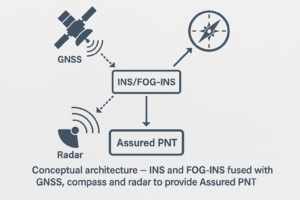
INS-Based Anti-Jamming vs Traditional Anti-Jamming
Traditional Anti-Jamming often relies on special antenna arrays (CRPA, nulling and beamforming). INS-based solutions take a different approach by using internal inertial sensors and sensor fusion. The table below compares these methods.
| Aspect | Traditional Anti-Jamming (CRPA / Nulling) | INS-Based Anti-Jamming (INS-D, FOG-INS) |
|---|---|---|
| Dependency on GNSS Signal | Requires GNSS signal to be present; performance degrades when signal is fully jammed. | Can maintain navigation even during complete GNSS blackout. |
| Hardware Complexity | Requires complex multi-element antennas and RF hardware. | Compact embedded unit, no special antenna array required. |
| Effectiveness in High-Power Jamming | Limited when jamming power is extremely high or close to the vessel. | INS is not affected by RF jamming; performance remains stable. |
| Installation | More complex integration and alignment of antenna arrays. | Simple mounting inside bridge consoles or equipment racks. |
| Cost | High due to specialised antenna arrays and RF subsystems. | Competitive, especially when factoring in full GNSS-denial resilience. |
Marine Use Cases for Anti-Jamming
Django Marine’s Anti-Jamming solutions are suitable for a wide range of vessel types and missions:
- Patrol & Coast Guard Vessels: Operating in high-risk regions where jamming and spoofing are common.
- Offshore Support Vessels: Working near critical infrastructure or in congested RF zones.
- Survey & Research Vessels: Requiring continuous, accurate navigation for data collection.
- Port & Harbor Craft: Operating in areas with heavy radio traffic and potential interference.
- Commercial Cargo, Tankers & Ferries: Ensuring safe route-keeping and collision avoidance.
| Vessel Type | Primary Concern | Anti-Jamming Benefit |
|---|---|---|
| Patrol / Coast Guard | Intentional jamming and spoofing in sensitive zones. | Maintains secure navigation and mission continuity. |
| Offshore Supply | Working near rigs and RF-dense regions. | Prevents position jumps and heading drift. |
| Survey / Research | Need consistent tracks for data campaigns. | Ensures repeatable tracks even when GNSS is unstable. |
| Harbor Craft | Signal congestion and interference. | Improves reliability of local navigation and docking. |
Django Marine Anti-Jamming Portfolio
- INS-D Series: Scalable Anti-Jamming position, heading and True North capabilities.
- FOG-INS Systems: Fiber-Optic Gyro navigation for high-endurance missions.
- Sensor Fusion Modules: GNSS + INS + compass + radar integrity checking.
- Bridge Integration: Interfaces to ECDIS, radar, autopilot, AIS, CCTV and other ship systems.
Why Partner with Django Marine?
Django Marine combines advanced Anti-Jamming technology with local knowledge and marine integration expertise. We support government, commercial and offshore customers across Qatar with:
- System design and solution engineering tailored to each vessel.
- Integration with existing bridge, radar, ECDIS and automation systems.
- Onboard installation, testing and commissioning.
- Training, documentation and lifecycle support.